
The venue is a lighthouse
More than a decade of lighting, video and production networking for the Huntington Lighthouse Music Fest — a concert played from the roof of an offshore lighthouse to an audience of boats.
Every Labor Day weekend for more than a decade, I’ve helped put a rock concert on the roof of a lighthouse.
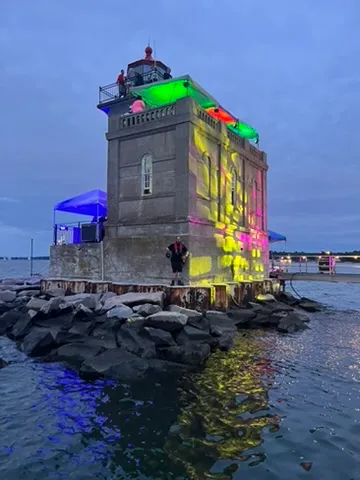
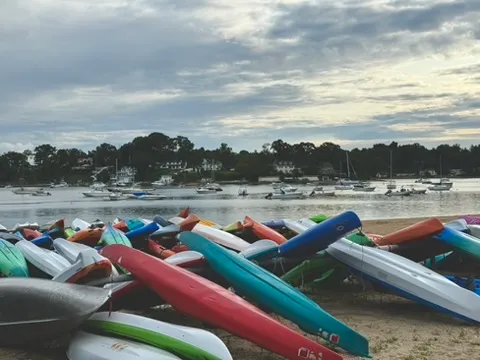
Not a lighthouse-themed stage. An actual working lighthouse — the Huntington Harbor Lighthouse, sitting offshore in Huntington Bay. The Huntington Lighthouse Preservation Society runs a music festival there, and it has grown into the Society’s largest annual fundraiser and a genuine Long Island boating tradition. Bands play from the roof from around 11 a.m. until dusk, and the audience floats: boats, kayaks, paddleboards, anything that holds a person, rafted up around the lighthouse in Huntington Bay and Lloyd Harbor. Public accounts have put the crowd in the thousands, with well over a thousand vessels some years.
From the water it looks effortless. From the production side, it’s the most instructive venue I’ve ever worked, because it starts with nothing and everything has to be built.
Why this venue is hard
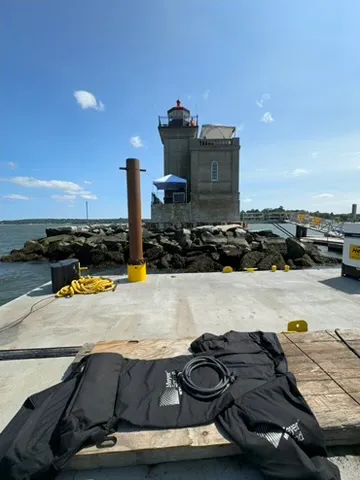
Start with what the lighthouse doesn’t have. Historically it has lacked dependable power for anything like concert production. There’s no loading dock, no house rig, no FOH position with sight lines, no closet with a patch panel. There is stone, water, and stairs.
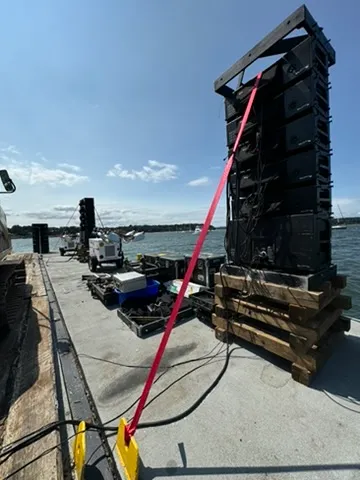
So everything comes by boat. Loudspeakers, instruments, cabling, generators, lighting, video, network gear, and every person who will touch any of it — all of it crosses the water, gets handed up onto the rock, and then gets carried up through the lighthouse to where it’s needed. The stage is the roof. Front of house mixes several stories below the performance area, which means the people mixing the show can’t simply look at the band, and every line between the two has to be run through a building that was never meant to host either of them.
Then, at the end of the weekend, the entire venue has to disappear again.
The network
My corner of this, alongside lighting and video, is the communications infrastructure: a temporary LAN, WAN and cellular setup that has to carry video, the livestream, production systems and general Internet connectivity from a site that offers none of its own.
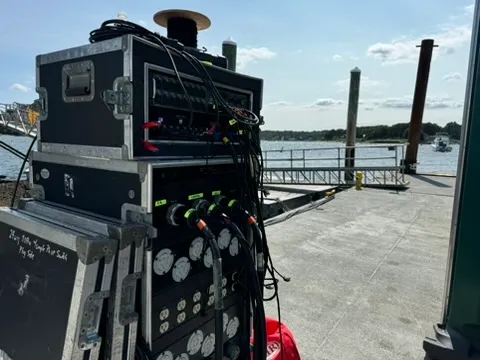
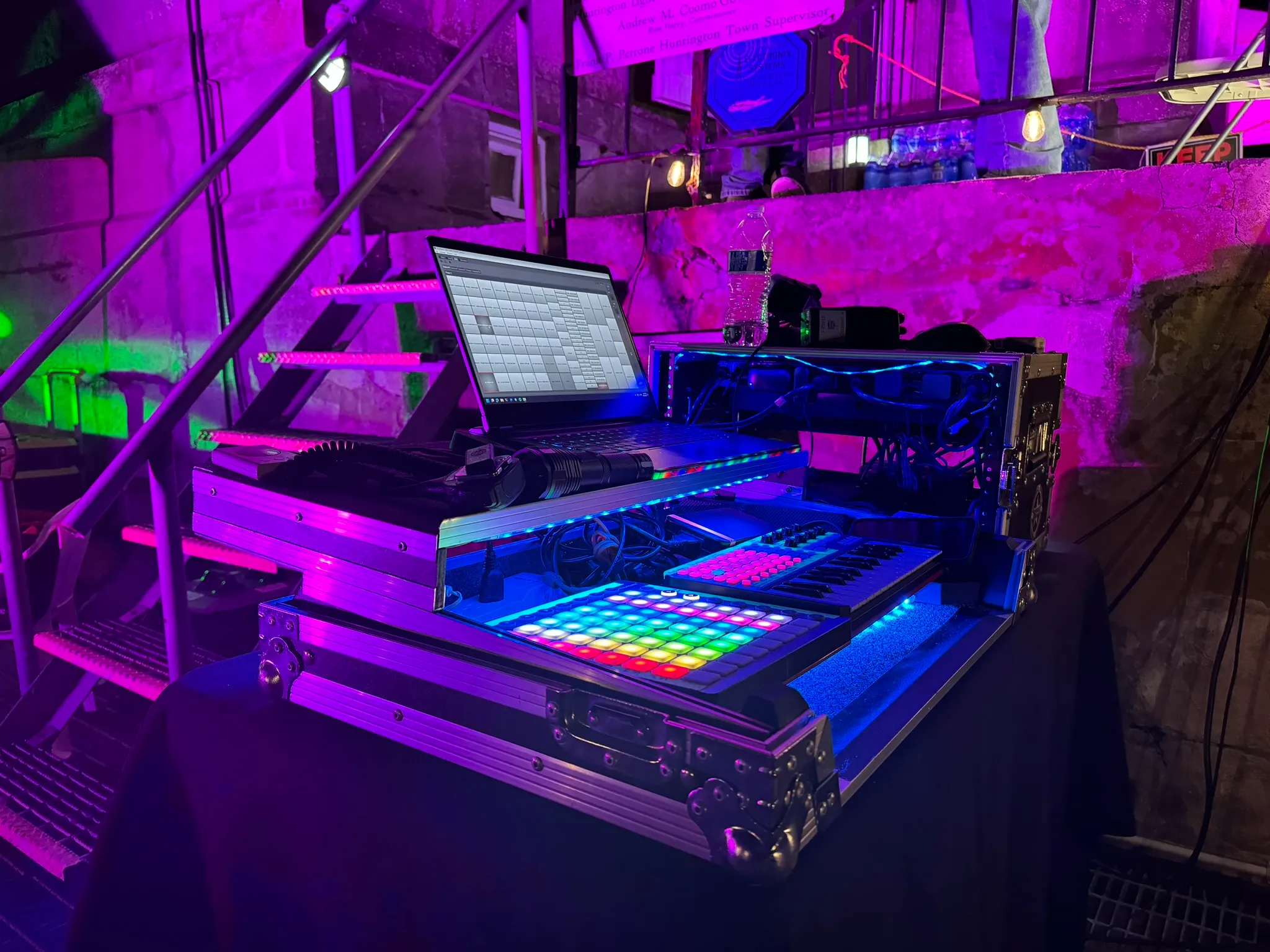
The backbone is wired and deliberately simple. We pull CAT6 to every fixed endpoint, a couple of Ubiquiti UniFi access points handle Wi-Fi, and unmanaged Netgear PoE switches carry the LAN — including the control network for the lighting rig. Nothing on that rock needs a managed feature set; it needs to work wet.
The WAN is the part people don’t believe: there is no circuit to order for a rock in the bay. Connectivity is cellular, through a CradlePoint E3000 carrying both T-Mobile and Verizon Wireless SIMs. It fails over automatically to whichever carrier is showing the better connection at that moment — lower packet loss, lower jitter — so neither network is a single point of failure. The CradlePoint handles both the WAN and the LAN for video streaming.
Audio keeps to its own island: a small wireless router of its own, with a full-size Behringer X32 at front of house and a second X32 handling monitor world up top with the performers.
Power starts on the barge. The main distro rides out there with the line arrays and a large-format generator, and feeds two pagodas on the lighthouse itself over three-phase five-wire camlock — lighting, audio and video power, each with its own path.
Lighting and video
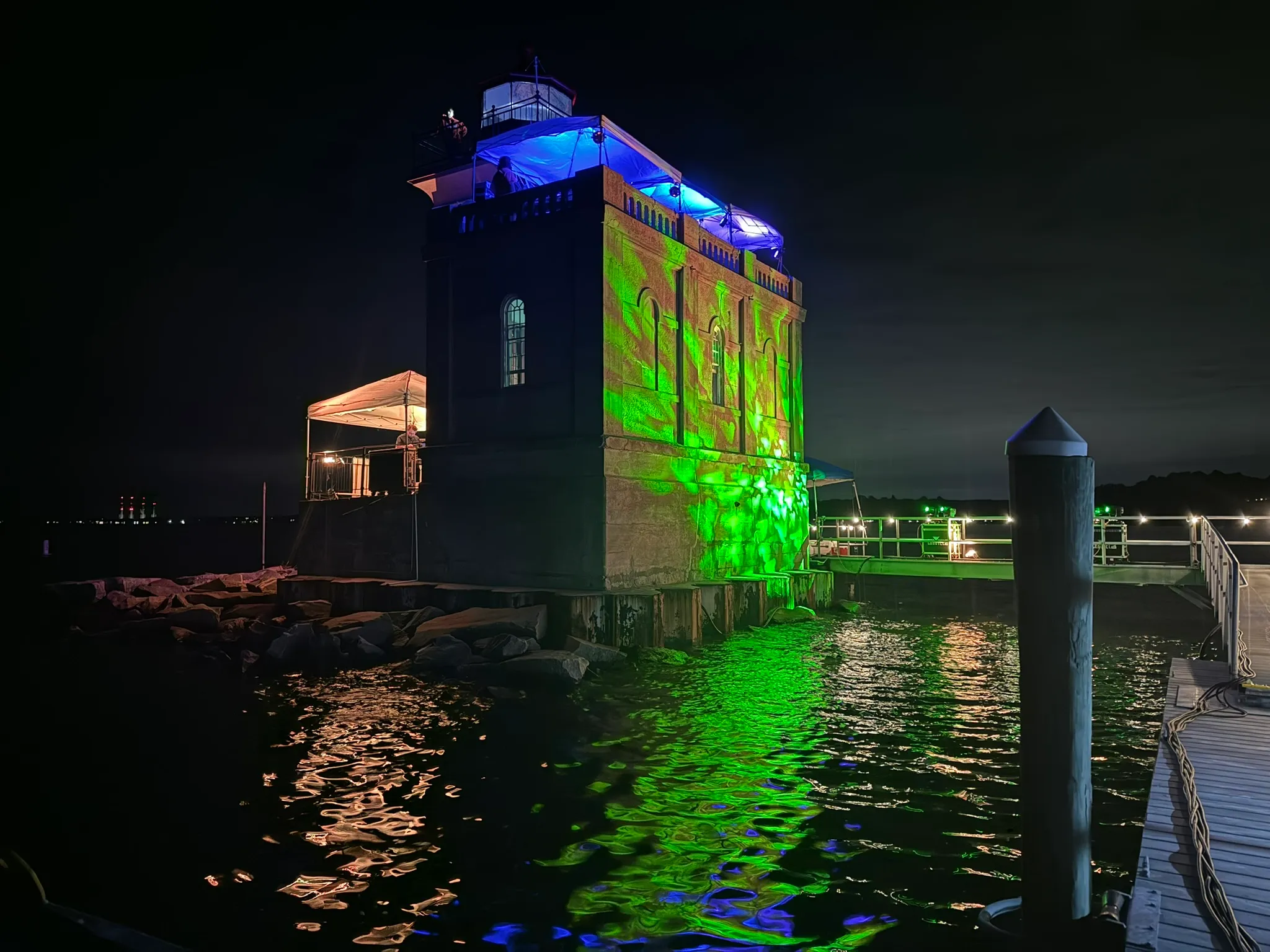
The other half of my job starts when the sun goes down. The lighthouse itself is the set piece, so we light it architecturally — washes across the stonework that read from a boat hundreds of feet away. The building becomes the backdrop, the lens and the landmark all at once.
The architectural rig is twenty-eight washes surrounding the building: fourteen Chauvet WashFX and WashFX2 units alongside fourteen SHEHDS RGBAW+UV fixtures, uplighting the stone and picking out the architectural pieces. On top of that, four Chauvet Intimidator 140SR hybrids run the psychedelic gobos across the building and the aerial effects over it.
Video rides the same infrastructure: four GoPro Hero cameras come back over HDMI-to-CAT6 balluns into a Blackmagic ATEM Mini Pro, with two laptops on the switcher for monitoring, streaming and content. While the stream is live, someone is in the chatroom the whole time, taking questions and reading donations in real time — it’s a fundraiser first. Alongside that runs multichannel audio recording of the sets. The audio side of the production has included Meyer Sound line arrays with fills, professional mixing and monitoring, and distributed audio built to carry concert-level sound across open water — a very different acoustic problem than any room, because there is no room.
The crew
None of this is mine alone, and it didn’t start with me. Donald Davidson and HDH Davidson Entertainment got involved near the festival’s beginning and took on sound, lighting, production, livestreaming and much of the technical logistics. As technical director, Donald grew it from a modest event into a large concert running on professional touring-grade gear. He passed away in 2023. His son Harley worked the festival at his side from the beginning, and he leads the production now — which feels less like a change of command than a continuation.
I’ve worked this show with Harley and the HDH crew for more than a decade. My primary lanes are lighting design and operation, and the video and network infrastructure; beyond that I do what everyone on a crew this size does — cabling, rigging, electrical distribution, load-in and load-out — under Harley’s leadership.
What the lighthouse taught me
My day job is infrastructure architecture: data centers, networks, virtualization, disaster recovery. The lighthouse is the same discipline with the abstraction stripped off.
Every dependency is visible. The power is a generator you carried in. The uplink is two SIM cards and physics. The cable plant is CAT6 you pulled through a stone stairwell yourself, and if a run fails there is no spare in a closet — the closet is on shore. You design for failure differently when the failure domain is a building surrounded by water and the maintenance window is a band’s set change.
It’s also the best argument I know that “IT infrastructure” and “production” aren’t different careers. The show needs a network engineer; the network exists to carry a show. Standing at a lighting console watching a wash roll across a hundred-year-old lighthouse, on a network you built that morning, the overlap stops being a novelty and starts being the job.
If you want the one lesson, it isn’t sophisticated: expect the unexpected. Everything is more difficult when it’s windy, wet and raining, there’s no permanent power, and the facilities are porta-potties on a rock. Design for that day, because that’s the day you’ll get.
An intermission
The 2024 festival was the 15th edition — and, for now, the most recent one. Music Fest has been on hold in 2025 and 2026 while major restoration work happens at the lighthouse. The right call: the venue comes first, and this one has been standing in salt water for over a century.
When the lighthouse is ready, the barges will load out from the beach again. I’ll be on one of them, with a spool of CAT6.